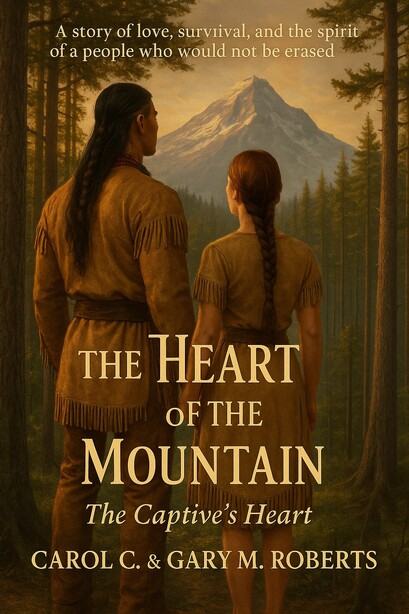
The Heart of the Mountain
Buy a copy today
ebook: Amazon I B&N I Apple I OverDrive I Kobo I Everand I Smashwords I curios $2.99
Sequel to A Captive's Heart
1836, Blue Ridge Mountains.
As the shadow of removal falls across the Cherokee homeland, two hearts stand against the storm.
Adohi, a young woman once caught between two worlds, and Tayané, a proud Cherokee leader, have fought to protect their people through hunger, exile, and loss. Now, as soldiers close in and the threat of the Trail of Tears looms, they lead a hidden band deep into the mountains — where faith, love, and the land itself become their only refuge.
Through the harsh winter and uncertain spring, Adohi and Tayané cling to hope, guided by the old ways and the whisper of the spirits who walk beside them. But survival comes at a cost, and when the promise of new life stirs within Adohi, their struggle becomes not only for their people’s future — but for the child who will inherit the heart of the mountain itself.
Told with lyrical prose and deep reverence for history, The Heart of the Mountain is a sweeping tale of love, resilience, and the unbroken bond between people and place. It continues the legacy begun in The Captive’s Heart and The Heart of Adohi, bringing the story full circle — from captivity, to courage, to renewal.
Excerpt
Taken from Chapter One:
The morning ritual of Going to Water had become as natural to Adohi as taking a meal. It was a ceremony as old as the mountains themselves — a cleansing in running water at daybreak; a time for meditation, reflection, and renewal.
The walk from their village was not far, close enough that one could call out and be heard if needed. Adohi carried a woven cloth to dry herself, along with soaproot and mint.
The stream ran clear and cold, spilling from a crevasse high in the rocks into a small pool below — deep enough to cover her shoulders. She laid her clothes neatly upon a bush at the bank, then slipped into the water, letting it rise around her. The chill sent a shiver through her, and she tensed, waiting for the shock to pass before dipping her head back and wetting her auburn hair.
Once accustomed to the cold, she turned toward the rising sun. With eyes closed, she let her thoughts drift. A small smile touched her lips as her mind went to Tayané. She remembered the night before — how he had returned from the hunt, a deer slung across his shoulders and laid it before Qaletaqa, the elder who had adopted her.
Tayané hadn’t told her what was said, but Qaletaqa had. He had placed the deer at her feet and knelt in silence until prompted. Qaletaqa had laughed softly when recounting it: “His words were slow in coming, but he finally asked to be joined to you.” She had teased him — “You took too long” — but agreed to the joining all the same.
Going to Water was meant to cleanse body and spirit, to wash away bad feelings and restore balance. It was a time for meditation and prayer. But Adohi’s thoughts would not settle into prayer — her heart was too full. She hoped the spirits would understand.
Still, she kept her eyes closed and tried. Only when she felt a faint, unnatural stirring in the water did she open them. Her breath caught — someone had entered the pool, intruding upon her sacred time.
She turned just as a hand reached for her. She gasped—
Tayané.
He had come so quietly, already within arm’s reach before she saw him. His strong arms drew her close, and for a long while they stood together, body to body, silent in the still water.
At last, Adohi spoke.
“This is my Going to Water time,” she said softly. “I’m supposed to be meditating and praying.”
Tayané tilted his head, a knowing smile playing on his lips.
“And how is your meditation?”
“I was meditating on things,” she replied, smiling back.
Tayané’s smile deepened as he studied her face. “On things,” he repeated softly, as though tasting the words. “And were they good things?”
Her eyes dropped, but the curve of her lips betrayed her answer. “They were… distracting,” she murmured.
He reached up, brushing a stray strand of wet hair from her cheek. His touch was gentle, reverent even, as though afraid she might vanish with the rippling water. The morning light caught the droplets on her skin, turning them to silver.
“The spirits may forgive distraction,” he said, his voice low. “Especially when the heart is strong.”
She looked up at him then, meeting his gaze. Between them hung the faint mist rising from the water, the breath of the mountain itself. Neither spoke. The air carried the scent of mint from the bundle she had brought, mixing with the sharp coolness of the stream.
Tayané’s fingers traced the line of her jaw, resting briefly beneath her chin. “You are certain of this joining?” he asked.
Adohi nodded. “I was certain before you asked,” she whispered.
For a long moment, they stood in silence, the only sound the soft rush of water over stone. He leaned closer, forehead resting against hers. The world narrowed — just the sound of their breathing and the sun rising over the ridge.
When he finally spoke, it was barely above a breath. “Then the mountains are witness.”
She smiled, her hands finding his. Their fingers intertwined, water swirling around them as if in quiet blessing.
The world seemed to still around them — no sound but the steady pulse of the stream. The sun, climbing higher, spilled through the trees and scattered light across the water in shards of gold.
Adohi’s breath came slow and even. Beneath the surface, her fingers brushed against his, then lingered. She felt the warmth of him through the cold, and that small contrast made her heart ache with desire.
Tayané’s thumb moved in slow circles over her hand as though memorizing its shape. “When I hunt,” he said quietly, “I listen for what the wind tells me. It speaks of change — always moving, never still.” His eyes lifted to hers. “But you… you are the place the wind returns to.”
She felt her chest tighten at his words. “And you,” she whispered, “are the sound it carries.”
The smile that rose on his face was faint but full of meaning. He drew her a little closer, enough that the water broke gently against their shoulders. She could feel his heartbeat beneath her palms, steady and sure.
They stood that way — no longer speaking, simply listening to the rhythm of the river and the unspoken vow that seemed to settle between them. A hawk circled high above, its shadow gliding once over the surface before vanishing into the trees.
Adohi tilted her head and rested it against his chest. “This place will remember,” she said softly.
Tayané’s arms tightened around her. “Then we will always return here,” he promised. “When the world becomes too loud.”
The water whispered around them, cool and constant. Neither moved. For a long time, the morning belonged only to them — two hearts, one still pool, and the mountain breathing quietly around them.
The sun rose higher, spilling light that danced in ripples across the water. Mist drifted in thin veils, soft as breath, wrapping them in quiet solitude.
Adohi lifted her face toward the warmth, her eyes closed once more. “The elders say the water remembers,” she said, her voice barely above a whisper. “It carries every prayer, every touch, down to where the rivers meet. Maybe it will carry us too.”
Tayané’s gaze followed the current as it slipped through the stones. “Then we should give it something worth remembering.”
He released one hand and reached for the bundle she had left on the bank. From it, he took a sprig of mint, crushing it gently between his fingers until its scent rose sharp and sweet. He touched the fragrant leaves to her wrist, then to his own, and let them fall into the water. The green leaves spun away, carried by the current.
“It is said,” he murmured, “that when two hearts share the same offering, the spirits take notice.”
Adohi watched the leaves drift, then looked up at him. “And if they do?”
“Then they bless the joining,” he said simply.
A wind stirred through the pines, bending their branches toward the water as though in answer. For a heartbeat, neither spoke. The sound of the forest deepened — the trill of birds, the rush of unseen wings, the steady murmur of the stream.
Adohi drew a slow breath, feeling the air move through her like something sacred. “Maybe they already have,” she said.
Tayané reached out, his fingers brushing the place where her pulse fluttered beneath her skin. “Then let this be our prayer,” he said.
They stood together, palms joined, letting the river move around them — a quiet current that seemed to hum with something older than time. The water took the light and scattered it in small diamonds, and for that moment the world felt perfectly still, perfectly whole.
The path back to the village wound through tall ferns and dew-heavy grass. The air was warm now, and the forest hummed with the low music of morning — cicadas, the flutter of wings, the faint rustle of leaves. Adohi walked beside Tayané in comfortable silence, her wet hair drying in the sun. Every so often, their hands brushed, the memory of the water still clinging to their skin.
As they neared the edge of the clearing, the familiar shapes of their homes came into view — bark lodges and smoke rising from small morning fires. But something in the air had shifted. The laughter of children was absent. Men stood in quiet clusters. At the center of the village, a small circle of elders sat together, their faces drawn and grave.
Tayané slowed his pace. “Something is wrong,” he murmured.
Adohi felt it too — the stillness that was not peace, but warning. Qaletaqa was among the elders, her woven shawl bright against the earth tones around her. When she looked up and saw them, her expression softened only for a moment before settling again into worry.
Tayané released Adohi’s hand. “Go to her,” she said softly. “Find out.”
He nodded once and stepped forward, joining the circle. Adohi stood a short distance away, watching as the men and women spoke in low, urgent voices. Their words drifted toward her in fragments — soldiers, boundaries, orders from the east.
After a time, Qaletaqa rose and came to her. “It has begun,” she said quietly.
Adohi frowned. “What has begun?”
“The whites,” Qaletaqa answered. Her voice carried the weight of age and sorrow. “They have started gathering our people to move them from the land. Far to the west.”
The words fell heavy in the still morning. Adohi’s heart clenched. “They cannot take us from here,” she said, almost a whisper. “This is our home.”
Qaletaqa’s eyes, dark and steady, held hers. “Home is not always where the body stands, child. Sometimes it must live in the spirit when the land no longer welcomes us.”
Across the clearing, Tayané remained with the elders, his shoulders tense, his jaw set hard. She could see the storm already rising behind his calm.
He turned then, meeting her gaze. The tenderness of the morning — the peace of the river — seemed to linger only in memory now. Between them, something unspoken passed: love, yes, but also a promise.
The circle of elders widened to make space for Tayané. The morning light slanted through the trees, glinting off the beads and silver ornaments that marked their age and standing. Smoke from the council fire rose straight into the air, carrying with it the scent of cedar and sage.
Old Austenaco, whose voice carried the slow rhythm of the mountains, was speaking. “The messengers came from the east,” he said. “They say soldiers have gathered near Fort Cass. They bring wagons — chains — and orders. Those who refuse to leave are to be taken.”
A low murmur rippled through the gathered men.
Tayané felt the words like a blow. “Taken where?” he asked.
Austenaco’s eyes met his. “To lands beyond the great river. They call it Indian Territory. They say it is for our good, to keep us ‘safe.’” His tone made clear what he thought of that lie.
Another elder, Tsula, shifted the fire with a stick. “We have heard this before. The whites promise one thing, then take two.”
From the edge of the circle came a younger voice — Danuwa, no older than Tayané. His fists were clenched, his tone hot with anger. “Then we should not go! Why do we sit and talk while they come to chain us like animals? Let them try — we will fight.”
A murmur of assent rose among some of the younger men nearby. One slapped his hand against his chest. “We still have our bows, our rifles. The woods are ours.”
Austenaco raised his hand, his voice deep but steady. “And how long will the woods protect you? One village against their guns? Their army?”
Danuwa glared into the fire. “Better to die on our land than to walk from it like beggars.”
The silence that followed was heavy, broken only by the crackle of the flames.
Qaletaqa spoke then, her voice calm but firm. “Anger feeds quickly, like fire on dry grass. But fire also burns what it touches. We must think, not rage.” She turned her gaze to Tayané. “And you — what do you say?”
Tayané hesitated, feeling the pull of both worlds — the fierce urge to defend what was theirs, and the quiet wisdom that spoke of survival. “If we fight now,” he said slowly, “we fight alone. But if we go, we carry our people’s heart with us. The land is sacred, but so is the blood that lives to remember it.”
Austenaco nodded solemnly. “There is strength in living. Even when the world would see us gone.”
But Danuwa spat into the dirt, rising to his feet. “You can live without pride if you wish. I will not.” He stalked away, others following, their anger trailing like smoke.
The council fell silent once more.
Qaletaqa’s gaze lingered on the flames. “When the river changes course, the fish must choose — swim with it or be crushed by its stones.”
Tayané said nothing, but his hand went to the small carved pendant at his neck — a hawk in flight. Its smooth edges were warm from the touch of his skin.
Far off, a crow called from the ridge — a long, hollow sound that echoed through the valley.
The elders looked toward the mountains. The world they had known was already beginning to fade.