The Merchant's Daughter
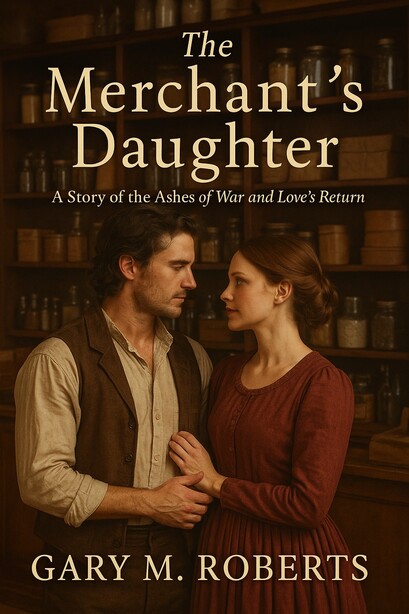
The Merchant's Daughter
1876, Georgia. The Civil War is over, but its shadows linger in the burned fields and broken lives it left behind. When Benjamin returns to his hometown, he finds only ashes—his family murdered, his home destroyed, and his future uncertain. With nothing left, he drifts into the struggling town of Clyde, sleeping on the steps of the mercantile and looking like a vagrant. Arabella, who owns the store after her father’s untimely death, drives him off that first day—only to discover that the boy she once knew has become the man who may change her life.
But not everyone welcomes Benjamin’s return. Arabella’s suitor, Charles, sees him as a rival and sets out to ruin him. When Arabella is robbed and shot, Charles seizes the chance to frame Benjamin for the crime. Though the true robber is caught, Charles weaves more lies, trying to pin every ill on the man he despises. His jealousy spirals into violence, and the dark truth emerges: Charles killed Arabella’s father to keep her—and to stop the dream of leaving Clyde behind.
As danger closes in, Benjamin and Arabella must fight for their lives—and for a chance at a future together. With the town dying around them, they face a choice: cling to the ashes of the past or risk everything for a new beginning.
Rich with tension, romance, and the grit of postwar Georgia, The Merchant’s Daughter is a sweeping tale of love, betrayal, and the courage it takes to claim tomorrow when yesterday still haunts your every step.
Excerpt
Taken from Chapter One:
Chapter One
Arabella Crawford’s mind was crowded with the new burdens of the day: how to bring sales up, how to stretch money that never seemed to be enough. Keeping the mercantile open was foremost in her thoughts. For years she and her father had run the business, scraping by as best they could. Now, with her father gone these past three years, the weight of it all rested on her shoulders.
The ride from home into town in her surrey took an hour each way, an hour out of an already long day. Still, the quiet road gave her time to think and plan. Her horse knew the way by heart, leaving Arabella little to do but turn her worries over and over.
So lost in thought was she that, when the surrey rolled past her storefront toward the livery, she did not at first notice the figure sprawled on the boardwalk, blocking her door. The livery boy, Curtis, hurried to take charge of her rig. Arabella called a distracted “good morning” over her shoulder and started the short walk to her store.
Life had been hard for the whole town since the war. The fighting was done, yet the struggle for survival had only begun in little Clyde, Georgia. Once a thriving county seat on the Ogeechee River, Clyde had been battered and burned in Sherman’s march of ’64. The rice plantations lay in ruin, and the town itself still bore the scars.
For the people who remained, one question lingered each day like a shadow: could they endure, or would Clyde fade into memory?
Her head bowed beneath the weight of the day as she stepped onto the boardwalk. The air was heavy with the smell of river mud and pine pitch, drifting in from the Ogeechee not far away. Clyde, once hopeful, now stood with more shadows than promise. Boarded windows lined the street, their planks weather-bleached and split, and the sagging fronts of shops whispered of fortunes lost. Even the cicadas seemed to drone in lament.
She lifted her gaze and halted. A man lay against the door of her mercantile as if it were a public bench. His wide-brimmed planter’s hat, stained with sweat and sun, obscured his face, though black hair spilled to his shoulders, and coarse whiskers jutted from his jaw like brambles. His cotton shirt, once white, had yellowed with wear, and his denim trousers bore the pale marks of long travel and harder days.
She called to him once, then again, her voice firm but not unkind. The man did not stir. Only on the third summons did he shift beneath the brim of his hat, lifting his head as though from the bottom of a deep well. With effort he pushed himself upright, hat still in hand, and she saw—against her first impression—that he was no weathered drifter, but young, perhaps no more than twenty-five.
He straightened as best he could, brushing dust from his shirt, and offered a weary, apologetic smile.
“Beg pardon, ma’am. I came late, and found no rooming houses open.”
She gave a soft laugh, light as the creak of the boardwalk beneath them. “There are no rooming houses in town anymore.”
For a moment he looked down the street, at the boarded windows and hollowed facades, as though to weigh her words against what he saw. Then, with a nod, he gathered himself, adjusted the brim of his hat, and stepped aside. His boots sounded hollow against the planks as he walked off along the boardwalk, leaving her doorway free but her thoughts unsettled.
She stood a moment longer, watching the young man’s figure diminish along the boardwalk until it was lost among the shuttered fronts. A faint echo of recognition lingered, but it drifted away like mist on the river. With a quiet sigh she turned back to her door, slid the key into the lock, and pushed it open.
Inside, the air held the close, dry scent of wood and dust. She moved by habit, setting her bag aside, striking a match for the lamps, and drawing open the shutters to let the pale morning light filter across the shelves. At the counter she lifted the till, counted out the coins with practiced fingers, the faint chink of silver and copper sounding far louder than the empty room warranted.
When the cash box was set in order, she carried a few baskets to the porch—apples, jars of molasses, a bolt of calico cloth—arranging them where passing eyes might notice. Yet even as she placed each item, she knew the effort was little more than a gesture. Business had been slow for months, through no fault of the townsfolk who remained. Since the war, many had gone already, chasing work, land, or some brighter promise elsewhere. Clyde stood thinner by the season, its heart worn hollow, and her mercantile endured more by stubborn will than by trade.
She brushed her hands against her apron, casting a glance down the quiet street. The boarded windows, the leaning porches, the silence—it all spoke the same truth. Still, she opened her shop as though it mattered, because that was what she knew to do.
She brushed her palms against her apron and let her eyes linger on the quiet street. More than once she had asked herself why she remained, why she bothered to sweep the porch and set out apples for neighbors who might never come. The answer, though, was always the same. This mercantile had been her father’s pride, built board by board with his own hands, and she could not yet bring herself to let it fall silent.
And then there was Charles Richardson. Charles, with his easy smile and his sure voice, who had stood at her father’s burial and promised her that better days would return. He was the town’s mayor now, its leading citizen, and by rights the owner of much of what was left of Clyde. When he spoke of rebuilding, of restoring commerce along the river, she wanted to believe him. She held fast to his vision the way a drowning soul might cling to driftwood.
Even so, the boarded windows and sagging porches whispered another truth, one she dared not name aloud. Her faith in Clyde was bound as much to Charles as to her father’s memory, and if either failed her, she knew the river itself might carry her away with the rest who had gone.
Still, she opened her doors each morning, arranged her wares, and waited for customers who seldom came. Routine was its own answer, even when the silence pressed hard against her hope.
The morning had barely stretched its limbs when the door swung wide, letting in a rush of light and the sound of boots on her floorboards. Charles Richardson filled the threshold as though the shop had been built to frame him—tall, broad-shouldered, his dark coat brushing clean against his trousers, his smile as ready as ever.
“Arabella,” he said, tipping his hat with practiced grace. “I swear, the sun shines brighter on Clyde when you open these doors. This town’s bones may be weary, but it’s a living place yet. I’ve news of investors in Savannah—men with real means, eager to put their coin to use along the Ogeechee. Mark me, trade will return here, stronger than before.”
He spoke with the rhythm of a salesman, every word polished to gleam, every pause crafted to make her believe. She had heard it often enough that it washed over her now, familiar as the drone of frogs at the river. Her thoughts wandered, slipping unbidden back to the figure she had found sprawled against her doorway at dawn.
There had been nothing threatening in him—nothing but weariness and need. She considered mentioning it, the odd encounter, but as quickly dismissed the thought. The man had gone without trouble, and to put it in Charles’s mind would do no good. Why stir the dust? He had been harmless, a traveler in search of nothing more than rest.
She nodded at Charles’s words, forcing a smile that he took as agreement. Yet part of her still lingered on the boardwalk, listening for the faint echo of boots fading into the emptiness of Clyde.
Charles’s words rolled on, bright as coin, until at last he narrowed his eyes and leaned a little closer across the counter.
“You’re not listening, Arabella.” His voice softened, but beneath it lay an edge. “What weighs on your mind?”
She startled, caught in the act of drifting. Her hands busied themselves with the till, though the coins had already been counted twice. “Nothing at all,” she said lightly, forcing her smile. “Only the heat, perhaps. It sets one woolgathering.”
He studied her, his handsome features arranged in concern, though she knew the look was as practiced as his speeches. For a moment she feared he might press further, that he might demand to know what thought had carried her away. But then his expression eased, the salesman’s charm slipping back into place.
“You mustn’t let this place wear you down,” he said, gesturing broadly to the shelves, to the town beyond the open door. “Clyde’s fortunes will turn, I give you my word. You’ll see. And when they do, you’ll thank yourself for standing firm.”
Arabella nodded, murmuring agreement, though her thoughts flickered once more to the young man on the boardwalk—his weary courtesy, his apology, his boots fading into silence. She pushed the memory aside with effort. There was no use in troubling Charles with it. The stranger was gone. Gone, and harmless.
She listened as Charles’s voice rose again, smooth and certain, filling the mercantile as though it were his stage. She had known that voice for as long as she could remember—through childhood games beneath the oaks, through the awkward years when boys first grew into men. Charles had always been the one spoken of with admiration, the catch of Clyde. Two years her senior, he had been marked out early, heir to the Richardson fortune, his family’s name etched deep in the rice fields and ledgers of the county.
By the time they were grown, it was simply expected that she and Charles would be a pair. Her father had welcomed it, neighbors had nodded their approval, and Charles himself had taken to it as he did everything else in his life: with a sense of ownership, as though it were no more than his due. To Arabella it sometimes felt less like courtship than an arrangement, something signed and sealed before she’d ever had the chance to consider whether her heart was truly hers to give.
He spoke now of investors, of the town’s revival, his gestures broad and commanding, and she nodded as he spoke, but inwardly she felt the old weight settle. He possessed a way of speaking that seemed to draw her in while leaving her voiceless, a way of guiding her thoughts until they echoed his own. She could not deny his handsomeness, nor the power of his charm, but beneath both lay a current of manipulation—subtle, insistent, as if her very loyalty were another asset in his keeping.
She folded a bolt of cloth on the counter, careful with the creases, her gaze lowered. It was her father’s mercantile that bound her here, but it was Charles who pressed upon her the vision of a future she wasn’t sure she had chosen.
And still, at the edges of her thoughts, there lingered the image of the young man in her doorway. He had been the first new face in months—dusty, weary, and yet courteous, his apology offered without expectation. A brief encounter, gone as quickly as it came, and yet it felt strangely freer than all of Charles’s practiced promises.
The door creaked again, and Arabella looked up, grateful for the interruption. A man stepped inside, the heavy tread of his boots marking him as a local rather than a stranger. It was Mr. Elmore, one of the town councilmen, his hat in his hand and his expression soured as if the sun itself had wronged him.
“Morning, Miss Crawford. Morning, Mayor,” he said, giving Charles a curt nod. “I’ve just come from the meeting house. Word is, that plan we set to bring in new families—gone to dust. The investors have cooled, or so they say. No one’s eager to tie their fortunes to Clyde.”
Charles straightened, his smile hardening around the edges. “Nonsense. The right men haven’t heard my pitch yet. They’ll see sense once they do.”
Mr. Elmore only shrugged, the look in his eyes betraying little faith. After a pause, he turned to Arabella. “I’ll take a cigar, if you’ve one left.”
She obliged, opening the small wooden box behind the counter. He chose one with care, laid down his coin, and tucked the cigar into his breast pocket as though it were a luxury from another life. With a polite tip of his hat, he stepped back into the sun, leaving the air close and still in his wake.
Arabella watched him go, her fingers resting a moment on the coins before sweeping them into the till. Business was business, even when it was only one cigar at a time.
As the door shut behind Mr. Elmore, silence settled over the shop, broken only by the faint clink of Arabella closing the till. For a breath, Charles stood unmoving, his jaw set. Then he struck his palm against the counter with a sharp crack that made her start.
“Fools,” he muttered, his voice low and taut. “Every last one of them. They sit in that hall, wringing their hands, blind to the future laid before them. No vision, no courage—just small men waiting for someone else to carry them forward.”
He began to pace the length of the mercantile, his boots heavy on the floorboards. The salesman’s tone was gone, replaced by something darker, edged with contempt. “Elmore and his lot would let Clyde rot where it stands if they had their way. They don’t deserve what’s left of this town.”
Arabella watched him, her hands stilling on the cloth she had been folding. She had seen flashes of this fire before, the temper that smoldered beneath his polish. It unsettled her, though she kept her face composed, offering no word to break his tirade.
At last he stopped, drawing a deep breath, smoothing his hair back as though to press the anger into place. His smile returned, though thinner now, like paint over a crack in plaster. “But no matter. Let the council doubt. I’ll see Clyde thrive again—with or without their blessing.”
Arabella said nothing. She lowered her gaze to the counter, smoothing the fold of the cloth beneath her hands though it needed no straightening. The weight of Charles’s words hung in the room, sharp as the echo of his hand striking the wood.
She knew better than to answer when his temper rose. His smile might have returned, but the fire behind it had not gone out, and any word from her would risk fanning it higher. So she busied herself in silence, arranging a jar of molasses, setting straight a stack of ledgers—small gestures of order in a world that felt increasingly fragile.
Charles watched her for a moment, as though searching for agreement in her quiet, before turning back toward the doorway. The salesman’s confidence settled over him again like a cloak, his broad shoulders squared, his stride measured. To anyone passing in the street, he would look every bit the mayor, the man of vision, the one destined to hold Clyde together.
But Arabella kept her eyes on her work, her thoughts her own, and let him carry his certainty out into the bright, unforgiving sun.
When the door shut behind Charles, Arabella let her hands fall still. The shop felt hollow again, as if his voice had been the only thing giving it weight. She glanced around the room—the neat rows of jars, the bolts of cloth stacked square, the baskets of apples waiting for buyers who seldom came. Each morning she opened the store with care, each evening she closed it with coins barely worth the effort.
It was folly, she knew, to keep on as though Clyde would ever be what it once was. The war had stripped it bare, and those who had the strength or means had already gone. The boarded windows, the leaning porches, the silence between the cicadas—all told her what her heart already understood.
And yet she could not let it go. This mercantile had been her father’s, built with his hands, his pride in every beam and shelf. To abandon it would be to abandon him, to let his memory fade into dust like the rest of Clyde. So, she kept the doors open, kept the till counted, kept the baskets on the porch as if the town might still draw breath.
It was duty as much as hope that bound her to the place. Duty to her father, and to a promise she had never made but could not seem to break.